
Porcine Reproductive and Respiratory Syndrome (PRRS) and swine influenza (IAV) are key pathogens that affect the productive performance of pig farms. At present, the commonly used oral fluid (OF) monitoring method, with its relatively high cost, sees limited application in the nursery and finishing phases.
To address this, a recent study published in the journal Porcine Health Management systematically evaluated a more economical and efficient alternative: using tongue fluids (TF) from dead pigs as a monitoring tool for PRRSV and IAV.
Today, Guanmu Precision Diagnostics takes an in-depth look at this study together with you, exploring how this "turning waste into a resource" sampling approach could bring change to disease prevention and control on pig farms.
Viral Load Head-to-Head: Tongue Fluids (TF) Show a Striking Advantage in PRRSV Detection
In PRRSV (porcine reproductive and respiratory syndrome virus) detection, the key advantage of tongue fluids (TF) lies in a viral load far higher than that of oral fluids (OF).
The study's data show that the mean Ct value of TF samples (29.1) was significantly lower than that of OF samples (32.8), which means the virus concentration in TF samples was higher. By contrast, the Ct values of the two sample types showed no significant difference when detecting influenza A virus (IAV).
Therefore, when procedures that place high demands on virus concentration are required — such as viral gene sequencing — TF, with its high viral load, is a better choice than OF.
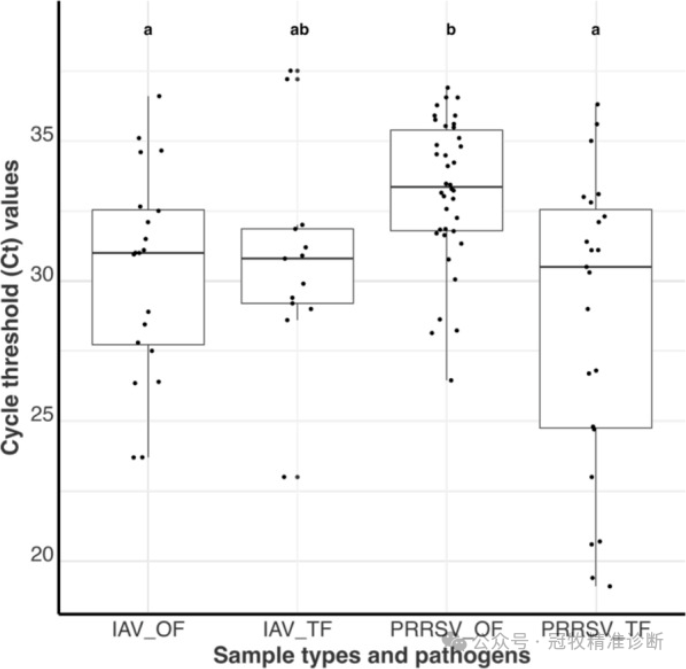
Distribution of RT-qPCR cycle threshold (Ct) values for IAV and PRRSV in oral fluids (OF) and tongue fluids (TF).
Tongue Fluids Greatly Improve the Success Rate of PRRSV Genetic Sequencing
Identifying which strain of PRRSV is circulating within a farm is essential for designing precise immunization strategies and tracing the source of infection. And whether genetic sequencing succeeds is closely tied to the viral load of the sample (i.e., its Ct value).
The findings of this study confirm exactly that. Among paired samples submitted for PRRSV ORF-5 gene sequencing, the success rate of TF samples reached 63.6%, while that of OF samples was only 45.5%. The study's model analysis showed that once the Ct value was controlled for as a variable, there was no statistically significant difference in sequencing success between the two sample types. This in fact reinforces the practical advantage of TF — it is precisely its "inherent" low-Ct (high viral load) characteristic that makes it the better choice for genetic sequencing.
The study even provides a precise reference value: for more than 95% confidence of successful sequencing, the Ct value of a TF sample should be below 21.06, whereas an OF sample would need to be below 22.17. For farms that have experienced sequencing failures because oral fluid samples had Ct values that were too high (viral loads too low), this is undoubtedly great news.
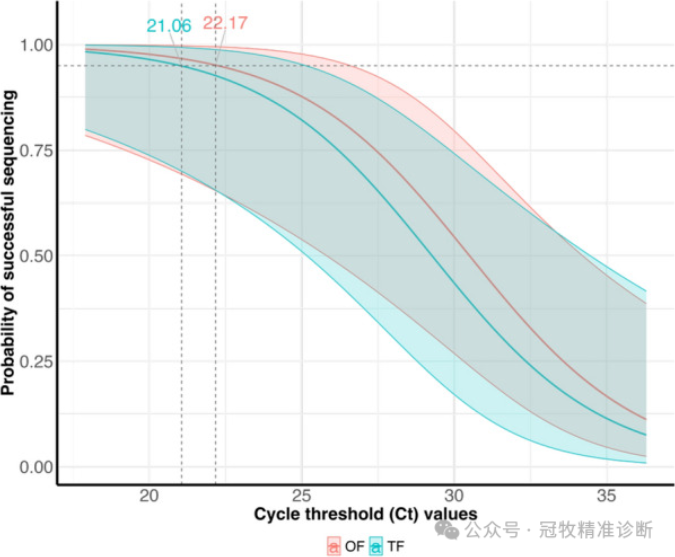
Probability of successful PRRSV ORF-5 Sanger sequencing in relation to RT-qPCR cycle threshold (Ct) values. The horizontal dashed line represents the 95% probability of successful Sanger sequencing. The vertical lines intersecting the horizontal line indicate the Ct values below which the probability of successful Sanger sequencing falls under 95% (22.17 for OF and 21.06 for TF).
The Optimal Balance of Cost and Benefit: The Feasibility and Power of a "Weekly Pooled Testing" Strategy
To reduce monitoring costs, the study evaluated a strategy of pooling tongue fluid (TF) samples collected daily for "weekly testing".
Although pooling samples raises Ct values due to a dilution effect (for example, mixing one positive with six negative samples raises the Ct value by about 3.46), its detection efficiency far exceeds that of testing single-day samples.
The model showed that when only one day in a week was positive, weekly pooled samples had a 79% probability of detection, far higher than the 14.3% for randomly testing a single day's sample. This confirms that "weekly pooled testing" is a practical monitoring option that balances cost and effectiveness.
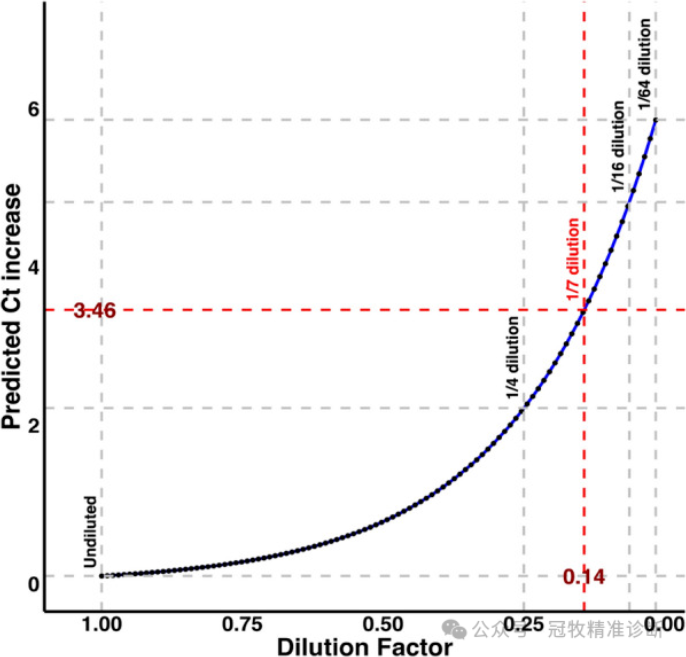
Predicted increase in PRRSV RT-qPCR cycle threshold (Ct) values with increasing dilution. The red dashed line indicates the predicted Ct increase (3.46) at the 1/7 dilution level (i.e., pooling one PRRSV RT-qPCR-positive daily TF sample with six PRRSV RT-qPCR-negative TF samples).
A Warning Signal: Mortality Points Straight to PRRSV Infection
The data show that when PRRSV alone was detected in a pig population through oral fluid (OF) samples, the weekly mortality rate (10.07) was 7.6 times that of populations with no virus detected (1.32). When PRRS was combined with co-infection by influenza A virus (IAV), this gap widened further to 10.5 times (mortality rate 13.84).
Whether oral fluids or tongue fluids were used for monitoring, this trend — PRRSV positivity being accompanied by a marked rise in mortality — was highly consistent. This data trend was also directly corroborated by the weekly mortality curves of the individual farms, where mortality peaks often coincided with the time points of PRRSV detection.
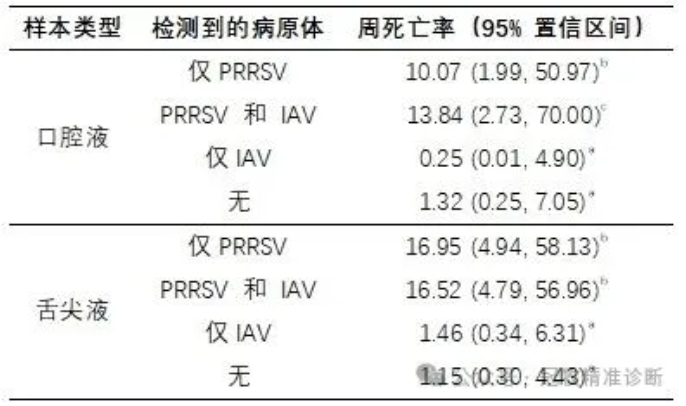
Pathogen detection status and weekly mortality (95% confidence intervals). Groups labelled with different letters differ statistically (p < 0.05).
Guanmu's Key Takeaways
Choose the better sample for sequencing: tongue fluids (TF), with their high viral load, are the better choice for PRRSV genetic sequencing. Their sequencing success rate (63.6%) is far higher than that of oral fluids (OF) (45.5%), allowing more reliable strain identification.
Embrace pooled testing: to save costs, a "weekly pooled testing" strategy with tongue fluids (TF) can be adopted. The study confirmed that even when only one day in a week was positive, the detection rate of pooled testing still reached 79%, combining economy with high sensitivity. Note, however, that for samples with extremely low viral loads, pooling and dilution still carry a theoretical risk of missed detection, so this is a strategic choice that balances cost and efficiency.
Build a complementary surveillance network: tongue fluids (TF) are a powerful complement to oral fluid (OF) monitoring, not a complete replacement. TF is suitable for collecting risk samples from dead pigs, but it still needs to be combined with live-animal sampling methods such as OF to build a comprehensive surveillance network. In particular, it should be noted that obtaining TF samples depends entirely on whether there are dead pigs in the population; during periods when the herd is in good health and no deaths occur, this method cannot be used, and the importance of live-animal sampling methods such as OF becomes especially prominent.
Improve sampling quality: to maximize diagnostic value, the tongue tissue from all pigs that die on a given day should be collected into the same sample bag. Pooling more tissue enhances the representativeness of the sample and ensures more reliable results.